Curatorial Exhibition
Curatorial Exhibition “How much?”
09.09–30.11.2026
NB!
Changes to the opening hours of the TAB exhibition “How Much?” at Linnahall.
Please note:
Wed, 23 September: the exhibition will open later than usual, at 17:30.
Fri, 25 September: the exhibition will be closed to visitors for the entire day.
Wed, 14 October: the exhibition is open 16:00 to 17:30
Thu, 15 October: the exhibition is open 16:00 to 17:30
Sat, 24 October: the exhibition will be closed from 14:30 to 16:00.
The exhibition will be open as usual before and after the visit.
We apologise for any inconvenience and look forward to welcoming you at Linnahall!
—
The notion of cheapness occupies a paradoxical position in architecture. It is rarely a quality the discipline openly aspires to, yet low cost remains one of the most persistent demands placed on construction. Cost, therefore, often becomes a dominant value in architecture, reducing the built environment to systems of cheap efficiency, calculated through the logic of the Excel sheet. This exposes a widening gap between the resources available and the value expected from architecture. The curatorial exhibition of the Tallinn Architecture Biennale 2026 brings this gap to the foreground and asks how it might be critically addressed through architectural means under the overarching question “How much?”
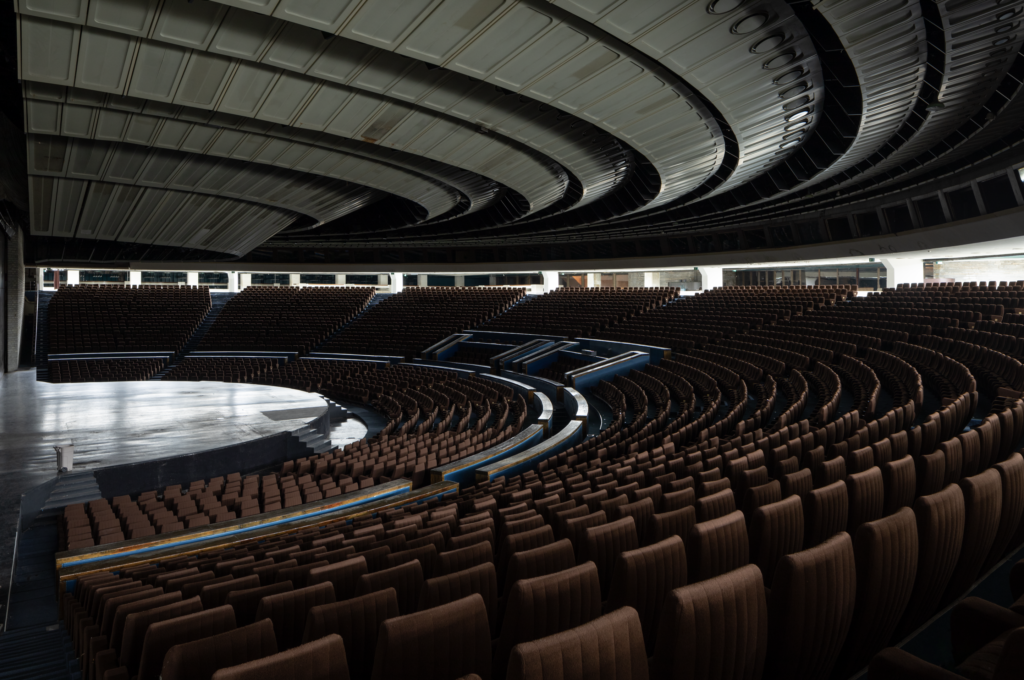
The main hall at Linnahall. Photo by Martin Siplane.
This inquiry begins with Tallinn’s Linnahall, the monumental modernist structure hosting the exhibition. Long abandoned yet continuously debated, the building itself embodies the Biennale’s central theme: reconstruction is considered too expensive, demolition equally so, while the postponement of decision steadily accumulates further material and cultural cost. Linnahall thus becomes more than a venue – it acts as a curatorial agent demonstrating that “how much” cannot be reduced to numbers on an Excel sheet, but unfolds as a spatial, political and temporal condition, as well as a question of value.
Linnahall materialises the Biennale’s inquiry into the relationship between constraint, cost and architecture, and limitation through its very structural and microclimatic realities. The exhibition unfolds in proximity to the legacy of the monumental civic investment, reactivating the building’s original main entrance as the gateway to the exhibition, its public spaces and interiors.
It sets off by unpacking the critical dimension of contemporary Excel architecture and the ways cheapness operates as one of its embedded imperatives. These first encounters – with both the building and the questions raised by TAB 2026 – establish a moment of critical reflection. As visitors move deeper into the building, the exhibition brings to the stage various architectural responses to grapple with these conditions. Within the iconic belly of Linnahall, the curatorial exhibition traces out a full-circle moment: showcasing works that refine, adapt and uncover opportunities where thoughtful design can, in fact, align with the demand for cost efficiency and affordability.
Overall, the exhibition gathers works ranging from critiques of architecture’s financialised condition to practices meaningfully exploring the gap between cost-optimised construction and value-oriented architecture. Rather than offering a singular answer to the question How much?, TAB 2026 opens it outward – inviting visitors to reconsider what architecture truly costs, how constraint can simultaneously open new perspectives in architecture and the forms of value it can produce.
Exhibitors and Projects
Estonian Collective Exhibit
Estonian architecture offices respond to the question: Which intelligent construction solution are you proud of, where restricted conditions still allowed architectural expression?
studio TAKK (Spain/New York)
TAKK is an architecture and design studio based in Barcelona and New York, founded by Mireia Luzárraga and Alejandro Muiño. The studio’s work critically engages with the integration of ecological frameworks into architectural discourse and spatial production, aiming to develop new material and political imaginaries for the built environment. TAKK operates at the intersection of professional practice and academic research. In 2025, they served as the curators of the Catalan Pavilion at the 19th International Architecture Exhibition of La Biennale di Venezia. TAKK’s work has received numerous accolades and is part of prominent international museum collections and exhibitions.
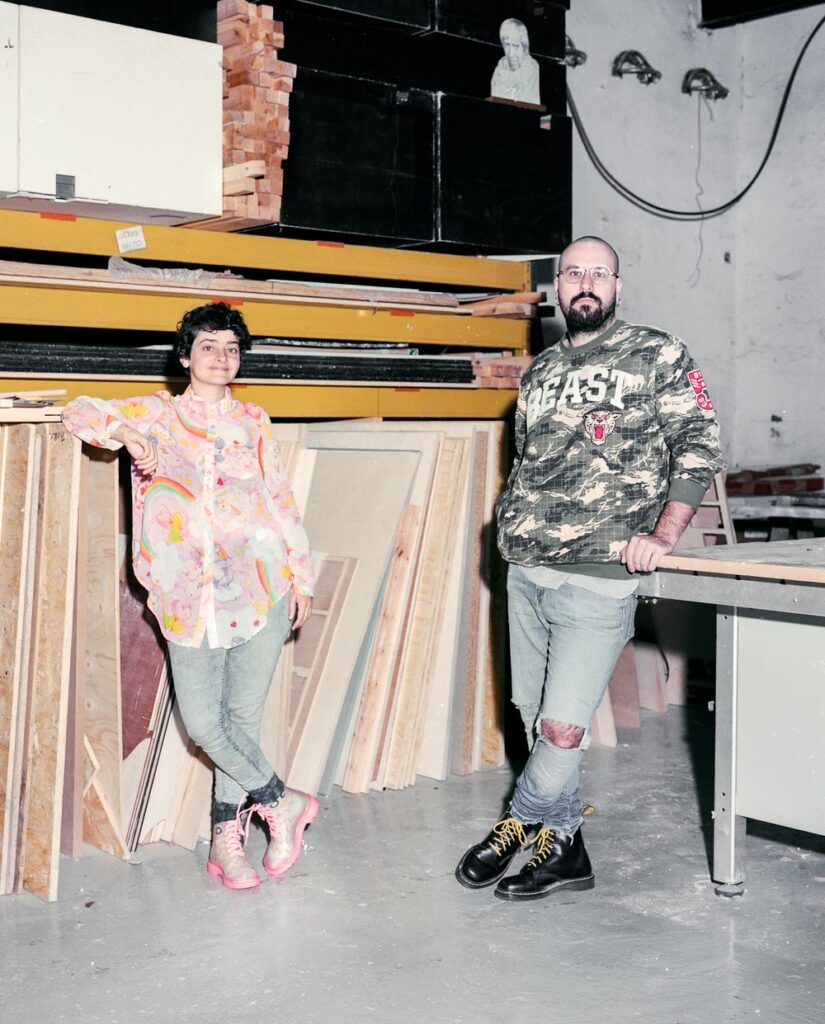
Studio TAKK_c-TAKK
Exhibit: 3K room
The spaces we inhabit are carefully designed to be comfortable – in various ways. But what does comfort actually mean in spatial terms, and how does it take material form? The project 3k room explores these questions by examining the relationship between cost and efficiency, value and comfort, climate and microclimate. The 3k room introduces an interspace to the exhibition that mediates these conditions. It reflects on interior climate, the dimensions of living spaces, and standardised notions of comfort through spatial experience.
asphalt / Kollektiv für Architektur (Austria)
asphalt is an architectural practice working across research, teaching, and construction. They discover the potential of existing spaces and structures while questioning established dynamics. A central concern is to represent and spatialise the contradictions and complexities of the present. asphalt is driven by a passion for creating spaces that meet the demands of our time, understanding architecture as a living, flexible system that generates momentum for progressive change. Through their work, the office actively advocates for transformation in the architecture and construction industry – towards a socially, economically and ecologically just and sustainable practice. These principles equally shape their own ways of working.
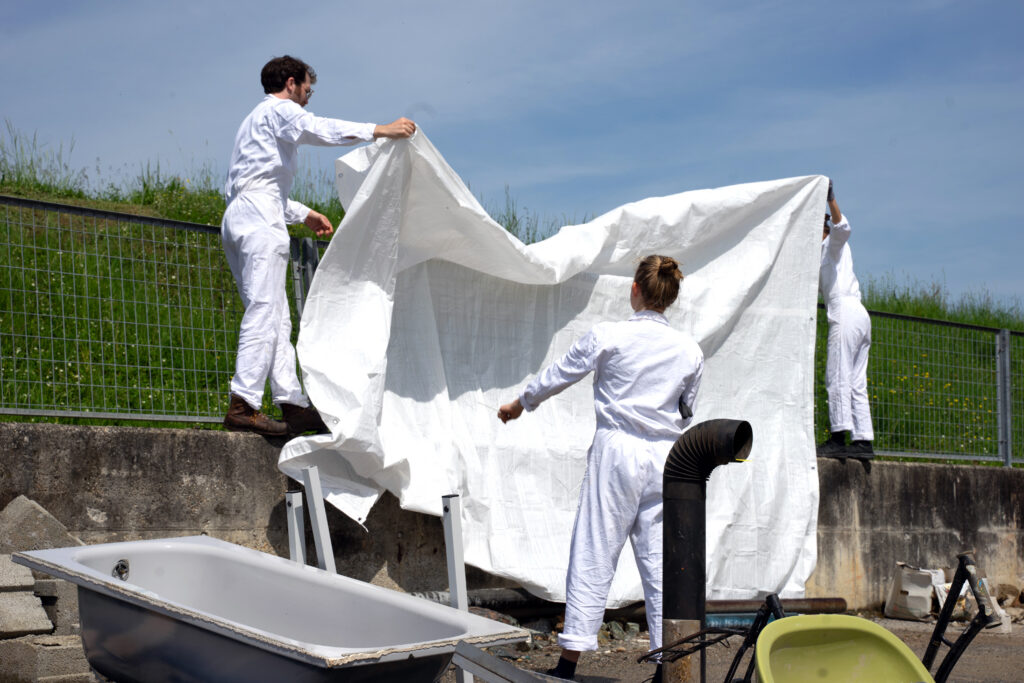
Asphalt / Kollektiv für Architektur
Exhibit: A Roll of Marble
The eye believes, the hand doubts. Marble is not hard and cool – it is soft, body-warm, yielding. The promise of permanence collapses the moment it is touched. This is no accident. Stucco, scagliola, veneer, laminates, printed tiles: architecture has always worked with deception. Gottfried Semper called this Stoffwechsel – one material assuming the form and cultural expression of another without possessing its substance. Marble can be rolled, printed, glued, transferred. Surface without stone, atmosphere without mass, a claim to value without a body. Contemporary building practice has radicalized this logic. Value is no longer produced; it is applied. Buildings have become media of cultural representation whose construction is entirely hidden behind their imagery.
The primitive hut asserted the opposite: a correspondence of construction, material and meaning. Today it is being reclad – not tectonically, but thermally. What we have invented is an architecture that looks like stone and feels like foam.
I am not convinced.
baubüro in situ (Switzerland)
baubüro in situ plans on site – with people, with the existing, with the local surroundings. Our offices in Basel, Zurich and Rolle are united by a shared commitment to creating a built environment that is liveable and sustainable. Through participatory processes and a respectful approach to existing resources, we develop projects that deliver lasting value. We work with the principles of the circular economy to actively help shape the future of construction. In doing so, we draw on the collective expertise and network that has emerged through our organic growth and years of pioneering work. Prioritising environmental goals over profit, we create spaces that foster a sense of belonging, conserve resources and demonstrate how sustainable architecture can work in practice.
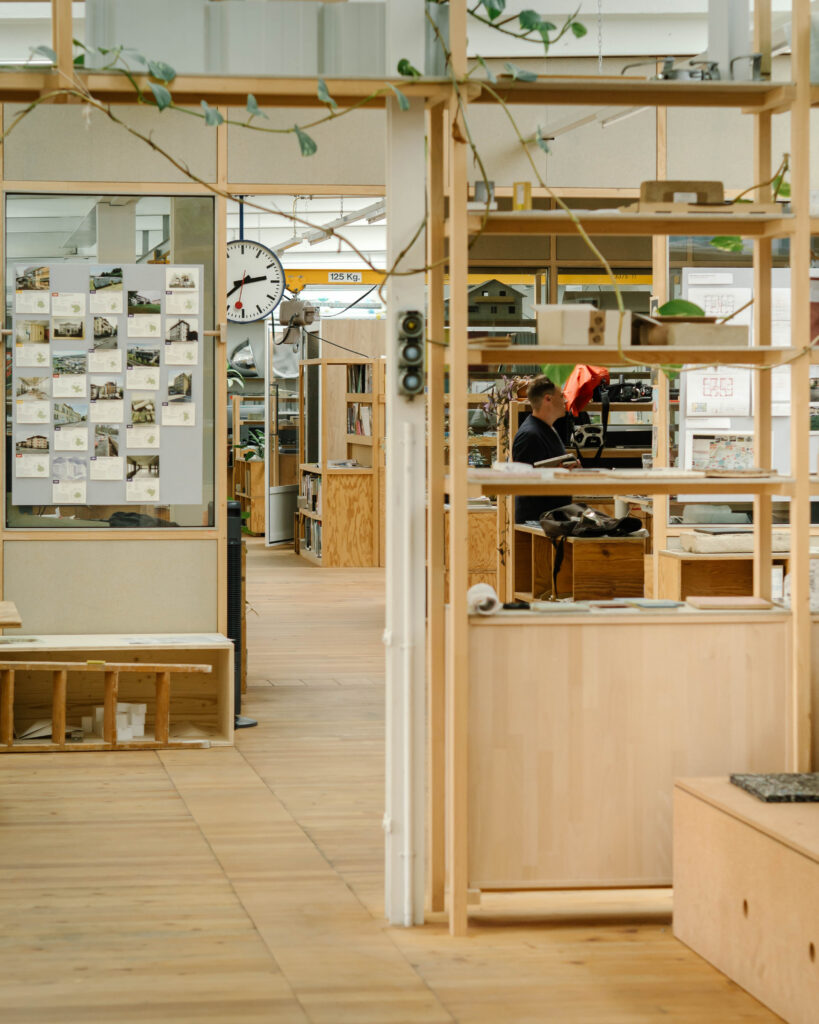
Baubüro in situ. Photo credit: Sibylle Jenni
Exhibit: Winkelbau 1, Zwhatt-Areal Regensdorf
“The Existing as Opportunity – Circularity as Vision”
Under the motto “The Existing as Opportunity – Circularity as Vision”, baubüro in situ has transformed the third floor of the Winkelbau office building into residential studios, prioritizing the preservation of the existing structure and the reuse of material. The original office layout and circulation routes remain largely intact, with only punctual repairs and adaptations to walls, wall finishes and flooring where necessary. New materials were used sparing-ly, with construction standards reconsidered in favour of sufficiency. For example, the reversibly built bathroom units are clad on only one side, existing floors were simply sanded, and most sur-faces remain untreated.
In many places, the service life of materials and building components has been extended through Re-Use. These reused elements are incorporated particularly into freely positioned room modules that function as “service cells,” zoning the apartments and encouraging the residents to appropriate and personalise the spaces. Overall, these measures reduced embodied emissions by 65 tonnes of CO2 eq (-43%) compared to an equivalent conventional refurbishment.
Following a two- to three-year pilot phase, the insights gained will inform the further building’s refurbishment, extension, and adaptive reuse of the entire building.
Avarrus Arkkitehdit (Finland)
Avarrus was founded in 2008 by Pauli Siponen and Niilo Ikonen and joined by interior architect Laura Karhunen in 2018. The studio is based in Helsinki, Finland and works with a special focus on renovation projects and larger architectural design projects as well as experiments with traditional construction techniques. Their portfolio ranges from new constructions to renovations, and varying scales from interiors to urban planning, amongst them for instance the Punavuori Stables, nominated for the 2023 Finlandia Prize for Architecture. Sustainability, adaptability and collaboration are key aspects for all of Avarrus Architects’ projects.
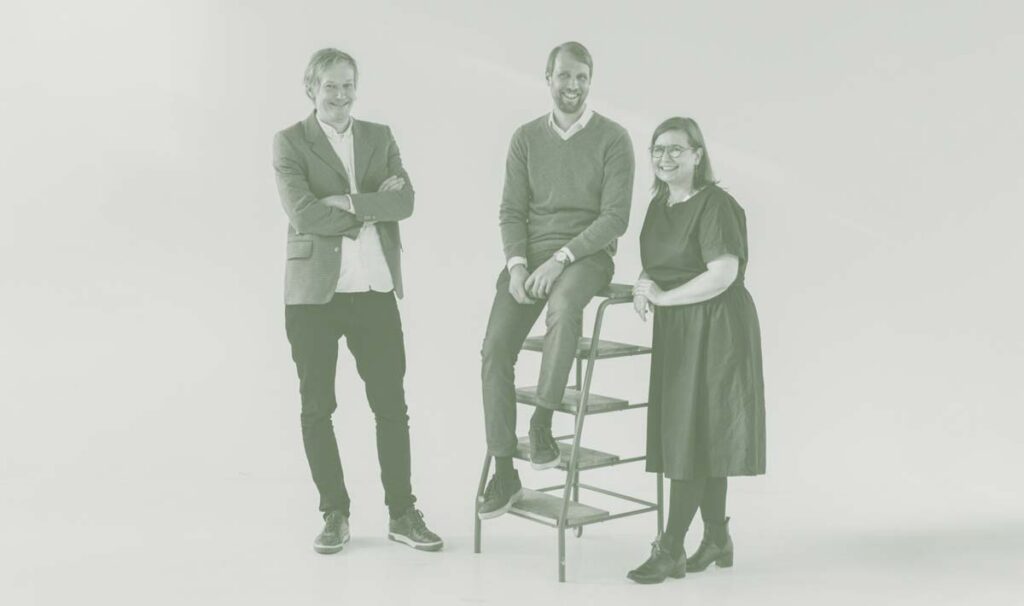
Avarrus Arkkitehdit. Photo credit: Nick Tulinen
Exhibit: Simply Massive
The installation Simply Massive looks at brick as more than a surface material. It focuses on how the material works with air, energy, mass, and cycle, and what that means in practice. In response to the theme How Much?, it approaches cost through use, lifespan, and material logic rather than short-term efficiency. The installation is based on the Helsingin Muurarimestari project, a massive brick building of 29 apartments designed by Avarrus Architects that explores these questions in modern construction.
AIR shows a masonry structure that breathes through natural ventilation, reducing the need for mechanical systems.
ENERGY presents the massive brick wall as passive heat storage, helping to keep indoor temperatures stable.
MASS considers monolithic construction as a way to build for durability and long use.
CYCLE looks at brick as a natural material that can be reused and returned into circulation.
HouseEurope!
HouseEurope! presents a short film addressing vacant office buildings and speculates about three possible strategies to reuse in the light of housing and resource pressures.
HouseEurope! is a community-driven non-profit for the built environment, founded in 2023, translating practical competency into policy and advocacy. It brings together people and organisations from across the value chain: from architects and engineers to contractors and material suppliers, from developers and investors to lobbyists and policymakers. Our work is rooted in direct experience within the building industry. We come from inside the practice, and this practical positioning is our core strength. We understand how decisions are made, where the limitations actually lie, and how, together, we can produce systemic change. That’s why we foster multidisciplinary dialogue and learn from each other to identify the biggest levers for change.
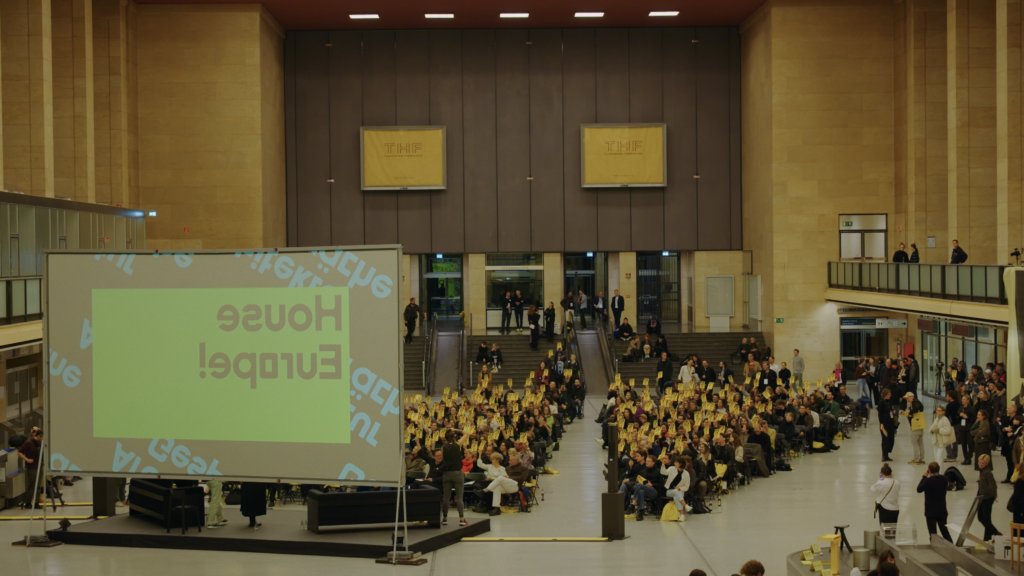
House Europe!
Exhibit: Sleeping Giants
The film explores the potential of vacant office buildings, often referred to as “Sleeping Giants”, to be converted into housing. Many European cities are facing a high proportion of vacant office spaces, which contrasts with the growing demand for affordable housing. Brussels is especially affected by this issue, with roughly 1 million square meters of empty office space. The story introduces three different strategies by three distinct actors for addressing office vacancy: an activist, a developer and an architect. These actors use a variety of strategies, covering everything from bottom-up initiatives like interim activations for artists and activists to top-down development and housing projects, to repurpose buildings.
Brussels, Zurich, 2024
Authors: Reto Kluser, Loris Müller, Julian Pauchard
Team: Severin Bärenbold, Olaf Grawert, Pan Hu, Meghan Rolvien
Contributors: Oana Bogdan, Olivier Robberechts, Ward Verbakel
Mantas Peteraitis Architecture Studio (Lithuania)
Mantas Peteraitis graduated from Vilnius Technical University’s Architecture and Urbanism in 2002. After a post-study period working in London for several architectural practices, since 2009 Mantas has operated under the studio name Implant Architecture. He has been involved in and completed independent architectural and exhibition design commissions, as well as collaborated with various artistic practices. Recently, Mantas has settled in Vilnius, Lithuania, and established his studio with a focus on the technological and aesthetic sustainability of his spatial practice and its impact on the broader community and ecosystems. Some of his most notable recent international works include ‘Mountain Pine Alphabet’, an installation part of a broader exhibition at the Venice Architecture Biennale in 2023, and an exhibition of architecture and object design for artist Lina Lapelytė at Lafayette Anticipations in Paris in 2022.
Mantas Peteraitis Architecture Studio
Exhibit: A User’s Guide to Building a Plastic-Free Architecture
At the dawn of the 21st century, the global community was promised a drastic reduction in plastic pollution. Decades later, statistics reveal a grim reality: plastic production and environmental toxicity continue to rise exponentially. The construction industry remains one of the largest consumers of synthetic polymers, hidden beneath layers of modern convenience. This project investigates this broken promise through the hands-on restoration of a 20th-century homestead. It proposes an “Architecture of Prevention” – a physical insurance policy against systemic microplastic contamination. The project systematically eliminates plastic from the building envelope and internal systems, replacing pervasive synthetics with rigorous, historically-informed, and bio-based alternatives where possible.
Márton Pintér (Hungary)
Márton Pintér presents a film addressing the compromises architects face in relation to cost, quality, market pressures and professional responsibility.
Márton Pintér is an architect, creative director and university lecturer. He graduated from the Moholy-Nagy University of Art and Design and later completed his doctoral dissertation at the Breuer Marcel Doctoral School. He co-founded Alfield with his former professor Péter Pozsár, an architectural agency and academy that challenges conventional disciplinary standards and makes architectural knowledge accessible to everyone. In 2025, he curated and designed the Hungarian Pavilion at the Venice Architecture Biennale. His works spans architectural projects, competition counter-proposals, critical writing, lectures and public debates.
MártonPintér. Photo credit: DoroNovak.
Exhibit: Export as…
A short film about Edith, an architect struggling with how architecture is being compromised by market demands.
Written and Directed by: Márton Pintér
Created by: Benjámin Kalászi (IG @kalasib)
Premiered at: Hungarian Pavilion’s exhibition titled There is Nothing to See Here at Venice Architecture Biennale 2025 (IG @noismore_ WEB www.noismore.com)
Curator: Márton Pintér (marton@epitesz2025.com)
Organised by: Ludwig Museum – Museum of Contemporary Art Budapest (https://www.ludwigmuseum.hu/en)
Commissioner: Julia Fabényi, Director of Ludwig Museum Budapest
Secretary (Sweden)
Secretary is an architecture practice founded and directed by architect Rutger Sjögrim and theorist Helen Rix Runting, joined by Josefina Martens. Operating across a range of media, Secretary’s work explores the capacity of architecture to support a dignified life at the scale of the population in the late welfare states of the twenty-first century. We make architecture that is political, experimental and infrastructural. Secretary has designed housing, industrial buildings, interiors, master plans, regional data archives, published books and essays, and undertaken concept design for film. The practice’s work spans multi-media installations, writings, research and education, often in collaboration with other practices from various spatial and artistic disciplines.
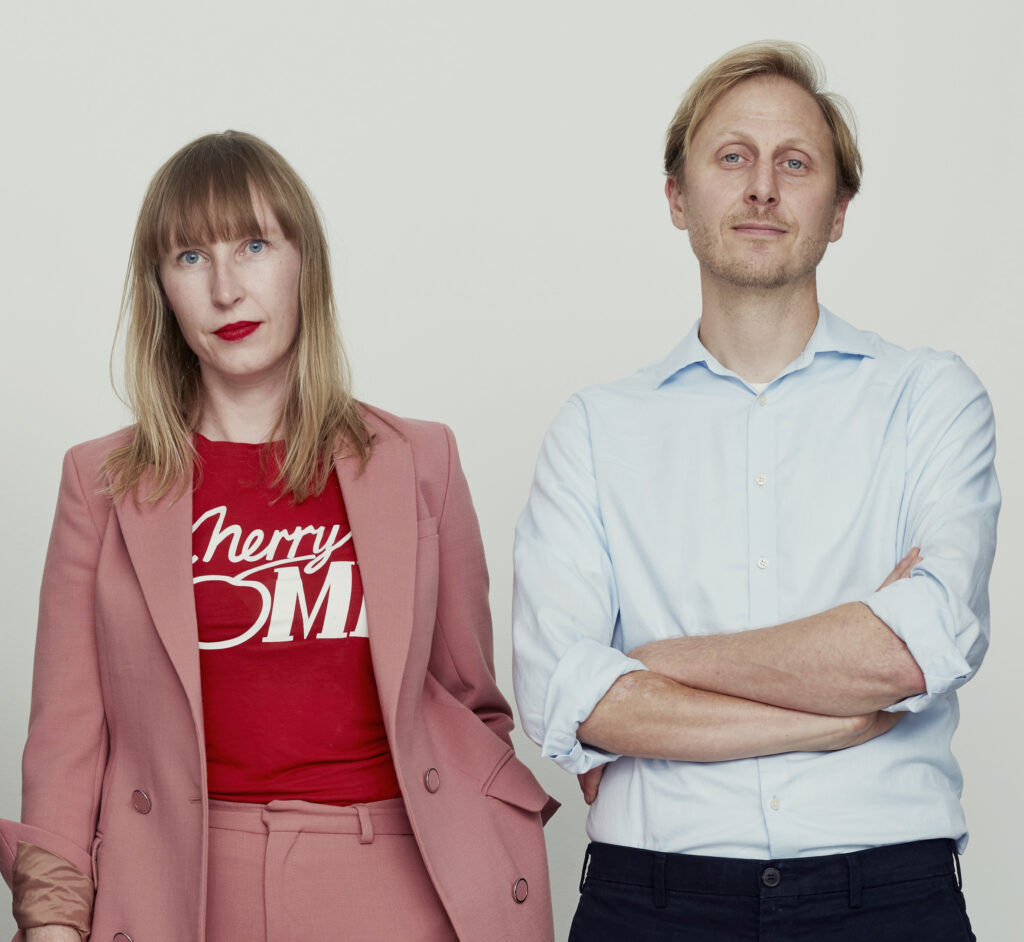
Secretary
Exhibit: Lost Hallway
The hallway. A space in between other spaces. A space that is liminal to the normative use (eat, shit, sleep, wash, rest, recuperate, entertain, etc.) of the home. When life just happens, the hallway is where it overflows. The hallway absorbs. It offers a form of flexibility that is generous and antithetical to the extractive efficiency of the neoliberal now, and through its liminality it brings the limits of other domains, rooms and territories into question.
We propose the hallway as emblematic of the good life. A life of surplus. A life that is not extravagant, exuberant, exhaustive, or extractive, but generous. Soft, and permeable. Lavish yet affordable. Reasonable. A life we all could have, can have, should have, will have, must have. A life that is future not past, and should be the bare minimum, for all of us, forever.
Anthony Clay Bureau/Tõnis Savi & Ester Kannelmäe (Estonia)
Anthony Clay Bureau is a Tallinn-based architecture and interior design practice founded by Tõnis Savi in 2014. The bureau works across architecture, interiors, public space and early-stage spatial consultation, with a particular interest in how buildings meet the street and how everyday environments shape the way people live, move and gather. ACB is small by choice, allowing direct involvement by the founder in every project, while drawing on a wider network of collaborators when needed. Alongside architectural practice, Savi’s work connects closely with mobility, street design and human-scale urbanism.
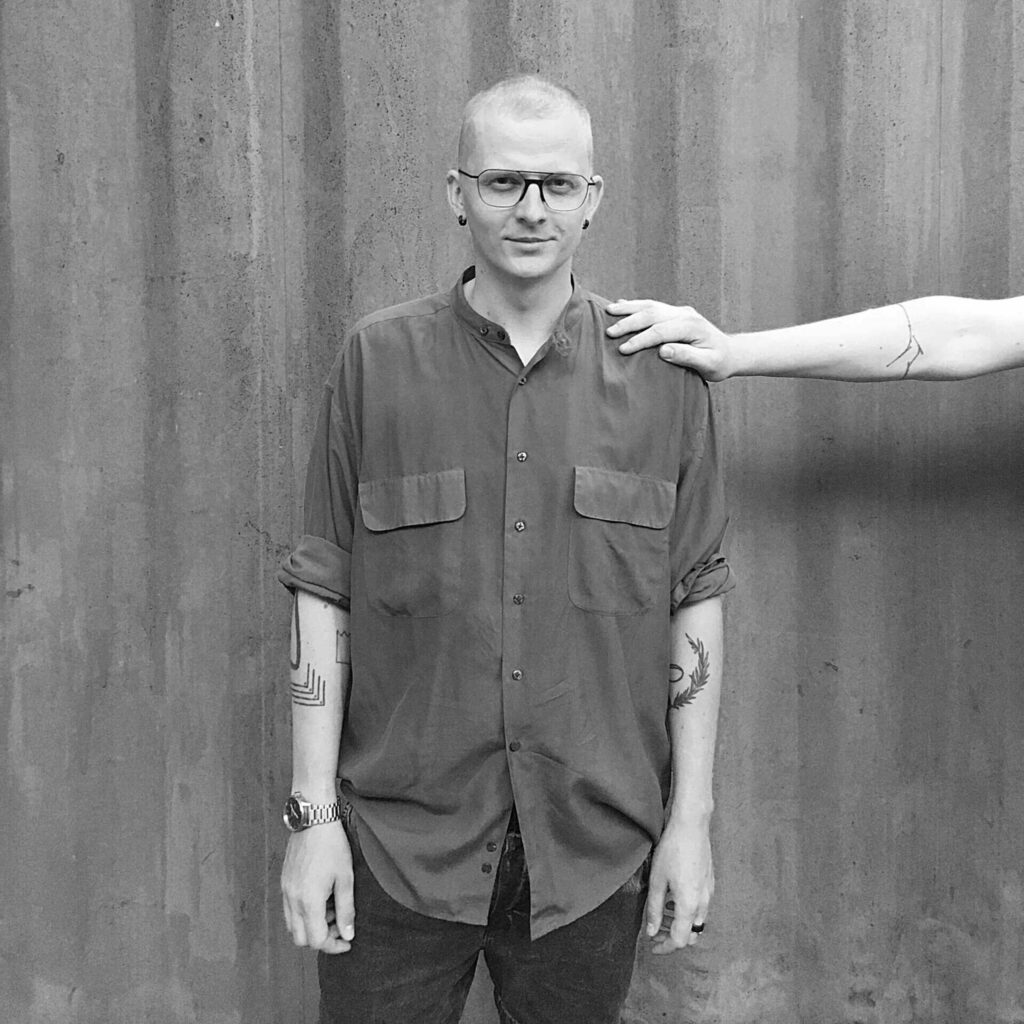
Tõnis Savi.
Exhibit: There Is Always a Bill
There Is Always a Bill is a critical inquiry into who actually receives the bill when we speak about what is spent — or not spent — on street space. The street is an architectural question because it is the city’s most public and democratic space: a place used by everyone, but still often evaluated through an outdated traffic logic of flow, capacity, parking spaces, regulations and construction cost.
The work places this alongside an understanding of the street as a space where social life, accessibility, climate resilience, environmental quality and many other questions meet. It does not look for a simple opposition between cars and people, cost and value, or building and not building. Instead, it shows how streets, buildings, mobility options, businesses, homes, well-being and public life are connected in the real world.
The installation is a temporary workspace with a branching mind map: a printout from a collective brain that has spent twenty years working with public and street space, mobility and the functioning of the city. It is not a final answer, but an unfinished calculation model of what we, as a society, are able to take into account — and what remains unnoticed when the street is treated too narrowly.
SALTO Architects (Estonia)
SALTO Architects presents a work related to Tallinn City Theatre, addressing the costs, constraints and architectural value involved in working with heritage and urban complexity.
Salto Architects is a Tallinn-based office established in 2004 and led by Maarja Kask and Ralf Lõoke. Their designs range from installations and triggering temporary objects to public buildings with significant social dimension and large scale built environments. In their practice Salto has taken particular interest in the meeting points between architecture, landscape design and art.
Significant part of their works is made up of public buildings, where a critical and interdisciplinary approach plays an essential role, e.g. Tallinn City Theatre, Viljandi State High School, Baltic Film and Media School, Estonian Road Museum, Tallinn Cruise Terminal, Fotografiska, Paide State High School, Saku Gymnasium to name some of the most critically acclaimed works. Salto Architects have also gained international attention and received awards for their installations and temporary objects, e.g. a prophetic Estonian exposition Gas Pipe at the 11th Venice Biennale of Architecture, the No99 Straw Theatre in Tallinn, critical infrastructural installation Fast Track in Russia, Tallinn Art Hall Lasnamäe Pavillon, Heat Wave in Cité de la Mode et du Design in Paris and others. Salto has received 2 Estonian National Culture Awards, 10 Cultural Endowment Awards and 4 Estonian Association of Architects Annual Awards.
The installation was created by Ralf Lõoke, Maarja Kask, and Märten Petersin.
Production: Märten Peterson.
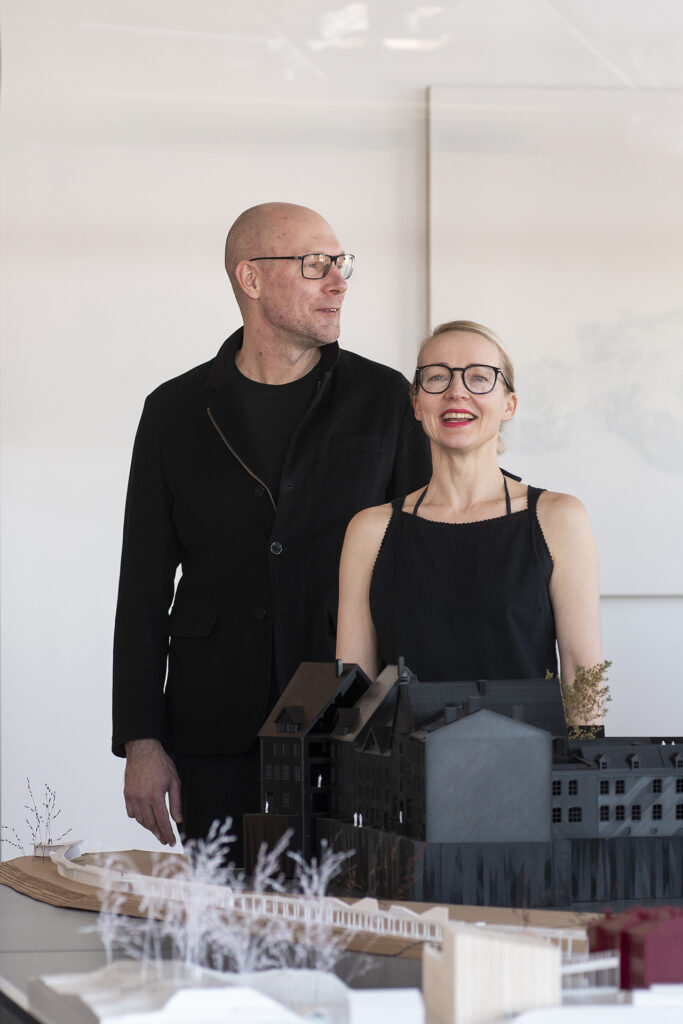
Salto. Photo credit: Terje Ugandi
Bimberg&Frenz (Germany/Belgium)
Bimberg&Frenz present a project examining literally currency and its relation to architecture. It re-evaluates the relationship between Euro banknotes and spatial representations of money, value and exchange.
Amelie Bimberg and Lea Frenz completed their architectural studies in 2020. Since then, they have worked for international offices including BeL – Sozietät für Architektur, Kawahara Krause, OFFICE Kersten Geers David Van Severen, AgwA, Bruther, l’Atelier Senzu, and Experience Paris. They have also worked as teaching and research assistants at Leibniz University Hannover and RWTH Aachen. Together with Jantje Engels, they held a year-long interim professorship in design and methodology at the University of Siegen. In parallel, they founded the ongoing collaboration Bimberg&Frenz, based between Brussels and Paris.
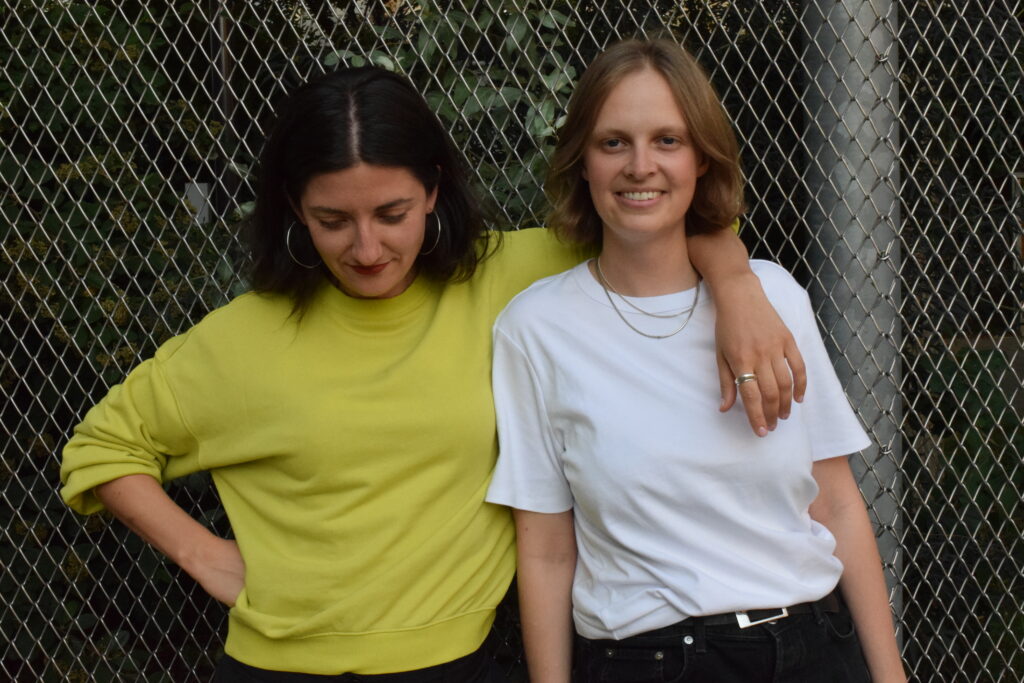
Bimberg&Frenz
Exhibit: CASH
CASH looks at the relationship between money and architecture through stories, objects and speculative proposals. It is a collection of different media that investigates the euro’s symbolism and imagery of bridges, windows, and gateways. The project arrives at a moment when the European Union is developing a new visual identity for the euro, one that may no longer include architecture at all. For this reason, 33 offices from across the Eurozone were asked to conrtibute alternative designs for a fictional euro banknote. The result is a CASH carpet of speculations on contemporary architecture and its representation on our common currency.[Text Wrapping Break]
Contributions by: 2001, Andreas Lechner, Antipas Jones, AREA, BeL — Sozietät für Architektur, Bernd Schmutz, Bovenbouw, Burr, Cortese Mazza, draftworks, EBEJER BONNICI, fala, Forms of Commons, Ivana Čobejová, Jean-Benoît Vétillard, KOSMOS, Krešimir Damjanović, list, LNCL, Madli Kaljuste, NERVIN, Nomos, Plural, Praktika, Sampling, Simple, Stand van Zaken, studio sotnas, Studio MAKS, ur bau, Veldwerk, Vidic Grohar, XIX.
Max von Werz Arquitectos (Mexico)
Max von Werz Arquitectos is an architecture practice based in Mexico City, with recurring attention to residential and hospitality projects. Founded in 2013, the studio approaches each commission from its particular conditions rather than a fixed style, seeking work that is practical, sensual and attuned to its environment. The practice has built in Mexico, Germany, the United Kingdom and Sweden, with each project rooted in its locale. Across these contexts, its work treats tradition and modernity not as opposites but as continuous. The practice is less concerned with novelty than with belonging to the place and time it inhabits. Max von Werz Architects presents a project addressing affordable housing, envisioning how new development and existing residential typologies can be integrated in Mexico City.
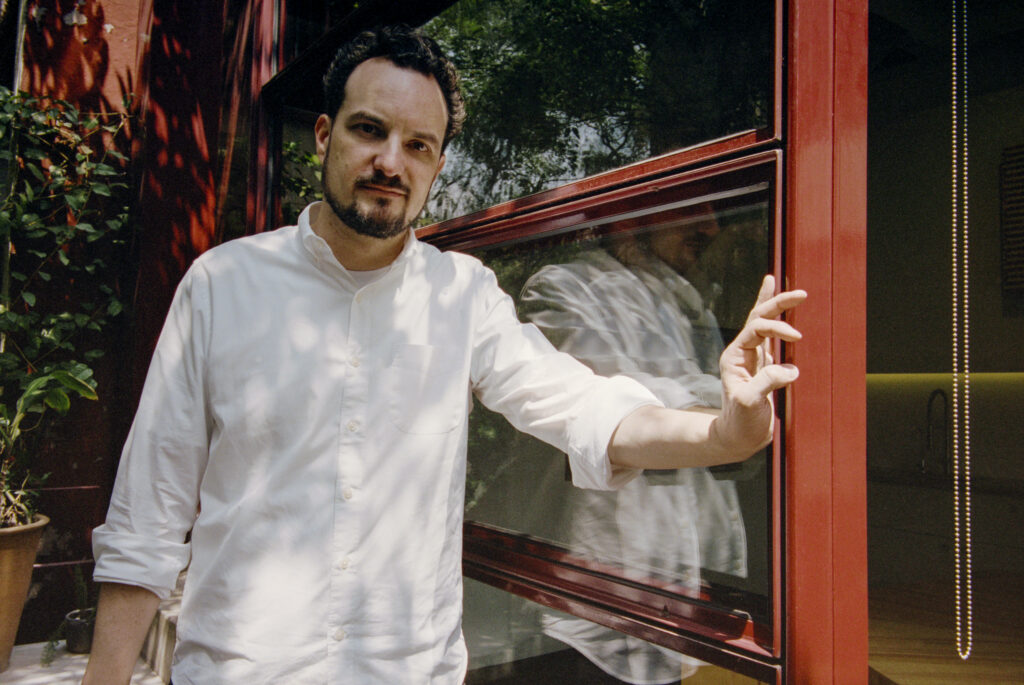
Max-von-Werz-Arquitectos. Photo credit: RosieMarks.
Exhibit: Under one roof
Prototype to densify the ‘Vecindad’ typology in Mexico City.
Vecindad Peralvillo 15 is among Mexico City’s oldest and largest historic housing communities: a typology endangered by neglect and urban pressure. The project addresses the need to densify and revitalize the vecindad without displacing its inhabitants. The central architectural move is radical and precise: remove the ceilings of existing ground-floor dwellings, transforming linear courtyards into communal gardens, while inserting a three-story social housing block Under One Roof above. Prefabricated-CLT panels and columns paired with corrugated sheet roofing combine sustainability with cost-aware, locally available materials. Existing patrimony walls are preserved and reactivated. The result is a prototype for densification that minimizes footprint while maximizing shared amenities using cross-ventilation, double-sided light, loggias, urban gardens and collective facilities reducing per-inhabitant built area and supporting self-sufficiency. The project demonstrates that the vecindad typology, far from obsolete, can anchor a more equitable, sustainable model for dense urban living in one of the world’s largest metropolises.
Max von Werz Arquitectos / Participants: Hiroshi Ando, Javier Castillo, Johannes Koch, Carlos Ortega, Max von Werz
O–P (New York)
Founded by two young architects working across New York, Jakarta, and Singapore, O-P, run by Eugene Ong & Andri Putri, is driven by a shared ambition to rethink architectural experiences by challenging conventional assumptions of value, atmosphere, and craft through perspectives shaped across multiple cultural and urban backgrounds. We started without fixed methodologies, but believe in approaching each project as opportunities to question how and for whom architecture is designed, constructed and built for. Our work seeks to spark delight, encourage participation, and center economic realities to engage the wider public, through attention to materials, details and the everyday systems that structure contemporary life.
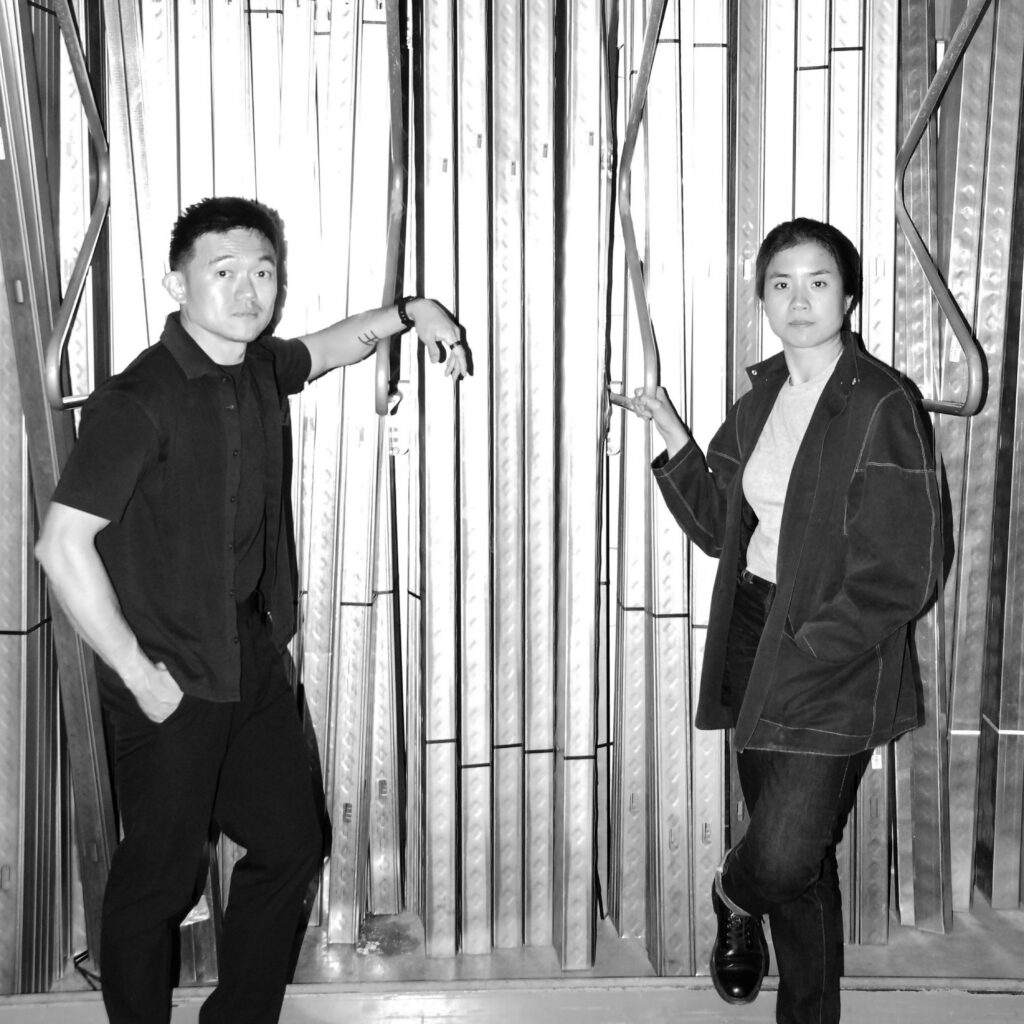
O-P. Photo credit: Yeong Jae Lee.
Exhibit: Ground Plane
Ground Plane is a housing proposal inspired by New York City’s City of Yes for Housing Opportunity plan (2024). Within this framework, it attempts to reposition housing not just as a question of size or efficiency, but as a lens on the relationship between aesthetics and value. Emphasizing cost efficiency, modular adaptability, and locally sourced materials, it explores the aspiration of “cheap” housing through 3 principles:
01 / Ground is treated as a flexible resource. Often the largest line item, the plane becomes both structure and space when given volume, producing a malleable topography that challenges conventional function and rigidity.
02 / Cosmetic finishes are minimized. The ADU is conceived as a bare-bones structure, with optional add-ons framed as DIY interventions.
03 / Ground Plane’s modular system relies on readymades. Users can customize layouts and design, while product familiarity demystifies construction and shifts value towards labor and detail.
SEE:4C. South-Eastern Europe
This research project investigates the legacy of socialist mass housing built between the 1960s and 1980s across Belgrade, Podgorica, Skopje, and Tirana. Analysing these residential complexes through the lenses of Timing, Legacy, and Agency, the project rethinks architectural value beyond extractive market logics, highlighting the social and environmental wealth of their active communities. This multi-nodal collaboration unites the Politecnico di Torino with four South-Eastern Faculties of Architecture (University of Belgrade, UKIM Skopje, University of Montenegro, and Polytechnic University of Tirana). Supported by the TNE-DeSK framework and funded by the Next Generation EU programme, the partnership leverages shared research to bridge architectural heritage conservation with European green transition objectives.
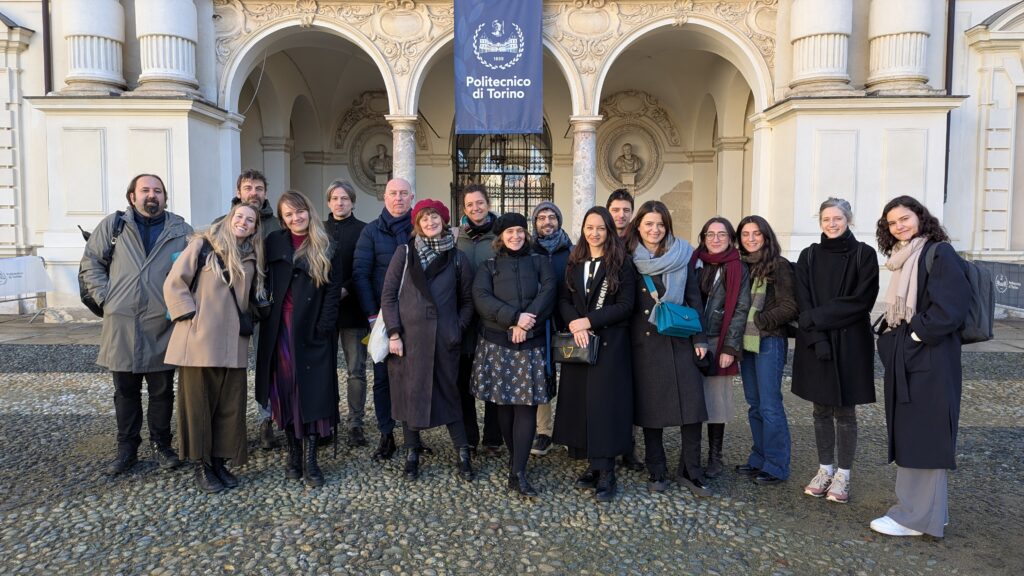
SEE:4C.
Exhibit: Load Bearing
Load Bearing takes its title from a precise structural term but extends its meaning far beyond architecture. These buildings carry not only physical weight but the accumulated burden of history, traces of memories and different uses. The project investigates the legacy of socialist mass housing in Yugoslavia, constructed between the 1960s and 1980s across Belgrade, Podgorica, Skopje, and Tirana. Built through prefabricated concrete as both a pragmatic and symbolic tool, these neighbourhoods materialised a collective vision of equality that today’s market logics have largely abandoned. Though often dismissed as deteriorated, they conceal thriving communities, generous public spaces, and an alternative model of shared infrastructure. Through the lenses of Timing, Legacy, and Agency, the research redefines architectural value beyond economic profit, proposing urban exaptation as a strategy to recover what these structures still hold up. An exhibition and forthcoming book present the findings.
KAVAKAVA (Estonia)
Kavakava works are site-specific, highlighting the potentialities of a particular place. At the same time their aim is always to provoke new situations. Kavakava projects are mostly public buildings or urban space designs based on prize-winning proposals for open architectural competitions. Next to the practice, active participation in numerous academic and theoretical discussions and teaching at the university are held important.

Indrek Peil ja Siiri Vallner. Photo credit: Mark Raidpere