Vision Competition 2026
From Void to Value: Revisioning Tallinn’s Old Town
Open Call to 1-stage Vision Competition for TAB 2026
Competition materials can be downloaded here.
The FROM VOID TO VALUE vision competition asks how the UNESCO-protected Gothic Old Town of Tallinn can be rethought as a socially and materially “cheap” urban structure—accessible, usable, and integrated with contemporary city life—despite strict heritage constraints and entrenched market pressures.
Conceptual background
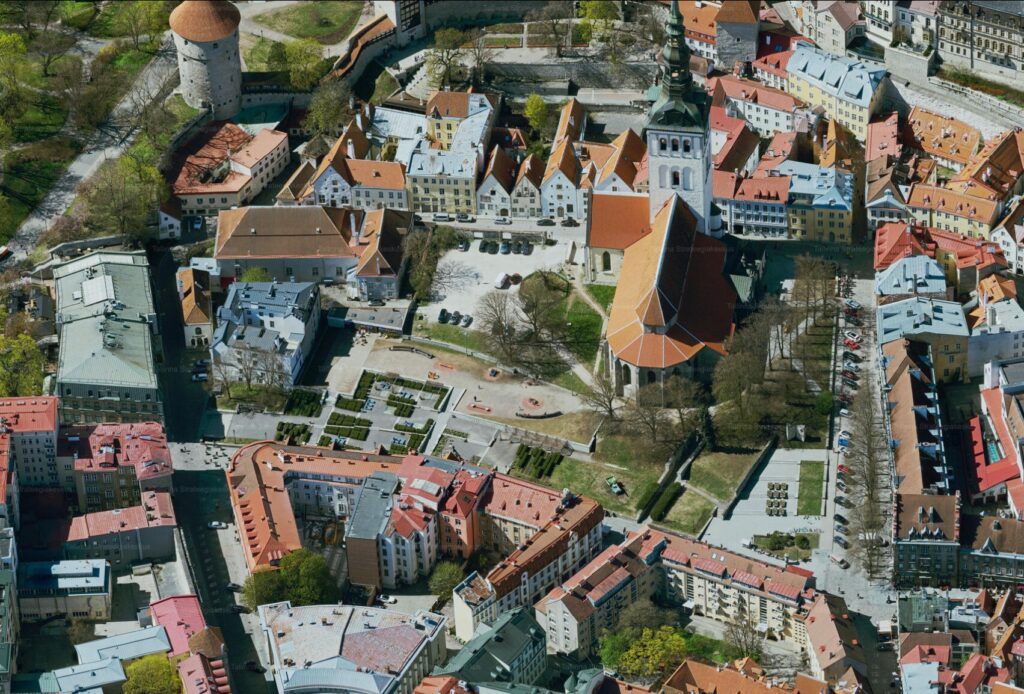
Tallinn’s Old Town is exceptionally well preserved in part because historical economic scarcity limited large-scale renewal: modern grids did not overwrite the medieval street and plot system, and later facade updates retained medieval load-bearing structures. Over time, continued use and conservation have amortized material costs, making the area physically cost-effective at a citywide scale. Socially, however, the Old Town has become expensive and increasingly detached from local life, shaped by comprehensive protection (from 1966), post-1990s privatization and neoliberal reforms, and the growth of tourism and commercialization. The competition frames this tension—low long-term physical cost versus high social cost—as its central problem.
Competition area
The site lies on the southern edge of the Old Town, forming a connective axis between the medieval core and surrounding districts. It is one of the few blocks destroyed in the Red Army air bombing of 1944 (Tallinn lost one third of its building stock). Since then, redevelopment debates have repeatedly resurfaced, making the site a persistent planning controversy. While the park functions as one of the Old Town’s few green public spaces (including use as an ice rink in winter), the open void interrupts the spatial continuity UNESCO values in the Old Town’s urban structure and weakens the spatial relationship between Town Hall Square and Freedom Square.
Vision task
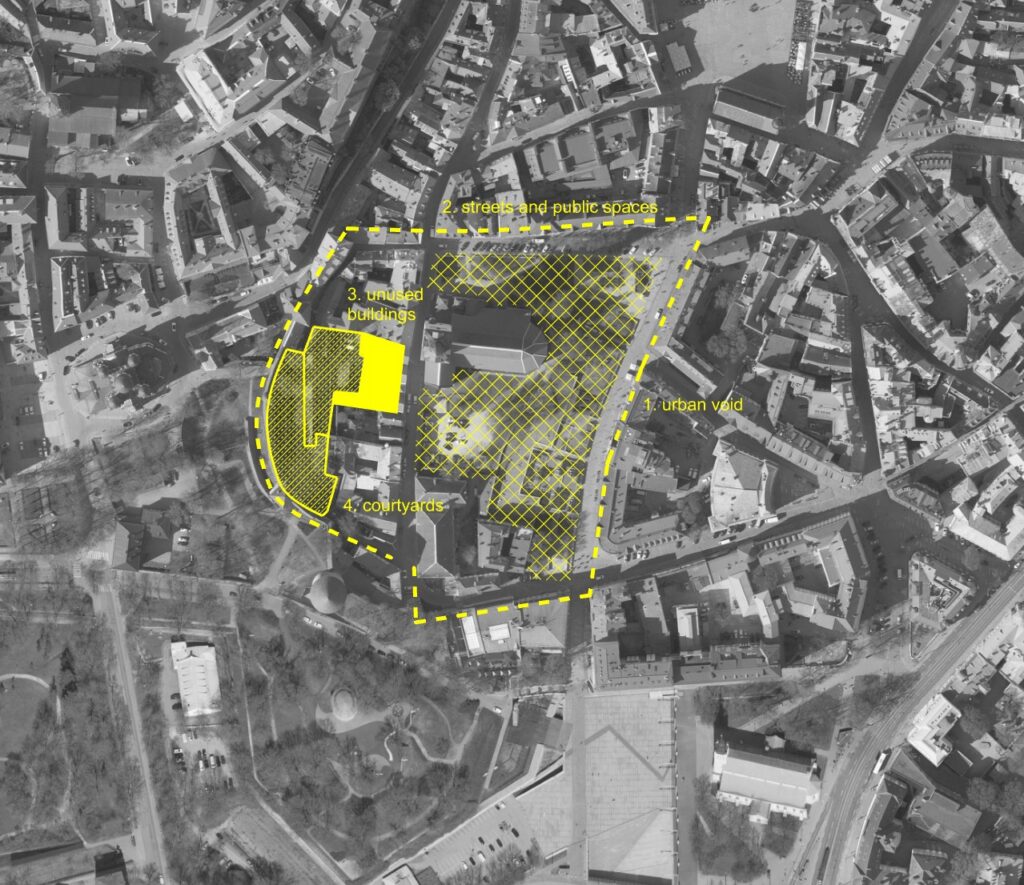
Participants are asked to treat the site not as a single object but as a set of typologies that reflects the Old Town as a whole, and to propose a coherent strategy for urban resilience and social sustainability in a historic context. Submissions should propose programme and function and demonstrate how these materialise in spatial and architectural form.
Key typologies to address
- Urban void (war relic): Harju Street open space (park since 1948) and comparable undefined spaces in the bastion belt.
- Streets and public spaces: the streetscape as the dominant public realm of the Old Town.
- Unused buildings: Rüütli 4 (municipality) and Rüütli 6, 8, 10 (Tallinn University), with no clear institutional vision.
- Courtyards: a sequence of hidden public spaces reached via covered passage, including a passable courtyard, terraced stair, and the Danish King’s Garden.
Guiding questions
- Value and the void: What gives value to an empty plot, and which users, activities, and structures would support long-term sustainability?
- Affordability of heritage: Where should the compromise lie between conservation and change, given high initial costs but long-term economic advantages?
- Cost of renewal: How do permanent vs temporary and expensive vs inexpensive interventions operate under heritage constraints and market pressure, and how can design enable or limit repurposing?
- Innovation within constraints: How can massing, aesthetics, technologies, and functionality negotiate between tradition and a radical direction forward, responding to growing spatial and social fragmentation?
Evaluation criteria
Submissions are expected to offer bold manifestos and a strong conceptual response to the TAB 2026 theme and brief, re-establishing the site’s relevance by reconnecting the Old Town with the wider city and its residents. The jury will assess:
- suitability and alignment with the brief;
- impact in social, economic, and contextual terms, with emphasis on integration with the wider city;
- contextual relevance to Tallinn, the Old Town, and the site;
- spatial integration of site-specific qualities and constraints.
Entries should communicate ideas in detail; representation should support the submission’s thesis argumentatively.
Prizes and presentation
- First prize: 4,499.99 €
- Second prize: 2,499.99 €
- Third prize: 1,499.99 €
- Five Honorable Mentions (no monetary award)
Winning projects will be exhibited in the main exhibition of Tallinn Architecture Biennale 2026. An atlas of selected concepts (1–3 prizes and honorable mentions) will be presented to the City of Tallinn and exhibited as part of TAB 2026.
Jury
The competition will be assessed by a five-member voting jury: four international professionals (architects, conservation specialists, and urbanists) and one TAB 2026 curator. Jury names will be published as confirmations are finalised.
Klaske Havik
Klaske Havik (Prof. Dr. Ir.) is Professor of Methods of Analysis and Imagination at the Faculty of Architecture and the Built Environment, Delft University of Technology. She has developed a distinct research approach that relates architectural and urban questions — such as the use, experience, and imagination of place — to literary language. Havik’s literary work appeared in Dutch poetry collections and literary magazines. For her contribution to the architectural debate, she received the Dutch Architect of the Year Award in 2014. Havik is currently leading the EU COST Research Network Writing Urban Places. Together with her students, she has investigated Tallinn through the studio A Matter of Scales at TU Delft.
Triin Talk
Triin Talk is a heritage and conservation specialist, PhD candidate, and researcher at the Estonian Academy of Arts (EKA). Her recent research focuses on the sustainability of historic urban environments, with particular emphasis on Tallinn’s Old Town, addressing issues of over-tourism, urban planning, and public policy. She has contributed extensively to professional and public discourse on heritage conservation and building practices in Tallinn’s Old Town, but also its liveability, role and meaning in contemporary society.
Keiti Lige
Keiti Lige is an architect currently serving as a Visions Architect at the City of Tallinn. She is a member of the architectural collective KEHA, through which she curated Estonia’s pavilion at the 2025 Venice Architecture Biennale, Are You Warm Enough?, and initiated a pop-up bar and community workspace in Tallinn’s Old Town. Her professional and research interests focus on the design of adaptive reuse, and material experimentation.
Siiri Vallner
Siiri Vallner is an acclaimed Estonian architect and partner at Kavakava. The office is widely recognised for its work on public buildings, heritage sites, installations, and research-based projects, and is considered one of the leading architectural practices in Estonia. Vallner is one of the authors of the Tallinn Main Street project, which runs along the edge of the Old Town, and she has played a key role in shaping discourse on the quality of public space in Tallinn’s historic urban core. Her work, like that of Kavakava, is characterised by sensitivity and an articulate dialogue with its surrounding context.
Siim Tanel Tõnisson
Siim Tanel Tõnisson is an architect, co-founder of the Tallinn-based stuudio TÄNA, and one of the curators of TAB 2026. Stuudio TÄNA was founded in 2021 by a group of architecture students from the Estonian Academy of Arts, and since graduating, the studio has engaged in a wide range of works, mainly focusing on public spaces, but also curating exhibitions and teaching. The practice emphasizes site-specific, thoughtful solutions that place users and social context at the center of design, while maintaining a broad and diverse approach to architecture. Siim has been active in teaching and writing, and his master’s thesis focused on Tallinn’s bastion belt and its structural role in shaping the city’s spatial organization.
How to enter?
Competition materials can be downloaded here.
The competition is an open, one-stage call. Urbanists, architects, landscape architects, interior architects and respective students are eligible to participate. Jury members—and their family members, relatives, and business partners—are not eligible.
There is no registration fee.
The competition is anonymous. Entries must be identified only by a project code, which is considered to be the project title of at least eight alphanumeric characters. The code must not reveal or suggest the identity of the author(s).
The working language of the competition is English. All texts, captions, and titles must be in English.
Submissions are digital only. Entries must be submitted as a single .zip or .rar folder (maximum 2 GB) via WeTransfer to info@tab.ee.
By submitting, participants grant the Estonian Centre for Architecture and the TAB curatorial team full permission to reproduce, translate, publish, exhibit, distribute, and circulate materials related to the 2026 FROM VOID TO VALUE Vision Competition.
Submission requirements
The concept and vision must be presented through the following:
- Abstract (max. 300 words) explaining the proposal.
- Cover image or up to three key visuals accompanying the abstract and representing the proposal’s vision.
Cover image format: 4266 × 3200 px, PNG (RGB), uncompressed, 300 dpi. - A3 digital project presentation incorporating all graphic material (e.g., drawings, diagrams, renders, collages).
Format: PDF
Written explanation, drawings, diagrams, and 3D visualisations should be presented as clearly as possible. Drawing and diagram scales may be chosen freely.
File naming
Folders and files must follow this naming convention:
- Folder: TAB_2026_Vision_Competition_[project code]
- Presentation: [project code]_presentation.pdf
- Images: [project code]_image_1.png
- Abstract: [project code]_abstract.pdf (or text format)
DEADLINE AND TIME FRAME
Competition launches: 09 February 2026
Competition closes: 27 April 2026
Digital submissions must be received by 23:59 EET (21:59 GMT). Entries that are not delivered in full or are not on time will not be considered.
The winners will be announced by 06 May 2026. All work will be exhibited as part of the Tallinn Architecture Biennale’s expanded program.
QUESTIONS
Questions are to be submitted via email to info@tab.ee by 23 of April, 2026. Questions and answers will be published on the competition page.
FAQs
What counts as a “key visual” for the abstract submission?
A key visual can be any strong image that clearly communicates your proposal’s vision. This may include a render, collage, drawing, diagram, axonometric view, map, or another visual format. The main point is that it should present the core idea of your proposal in a clear and comprehensive way.
What is the maximum number of A3 pages allowed in the digital project presentation (PDF)?
The digital project presentation may contain a maximum of 15 A3 pages.
Can I include text in the A3 presentation boards?
Yes. Additional explanatory text is allowed in the A3 presentation. Since the abstract is expected to provide a precise summary of the project, further clarification through text in the presentation is welcome.
Should all detailed project information be included in the abstract?
No. The abstract should be a concise explanation of the project. More extensive information should be presented in the digital project presentation.
How is the project code determined?
Participants create their own project code. There is no separate registration process for obtaining one. It is recommended to use the project title as the code rather than a numerical identifier, as this helps avoid duplication.
Are there any requirements for the project code?
Yes. The project code must be at least 8 characters long. If the project title is shorter than 8 characters, it may be extended with an additional word or short phrase for the purpose of the code only. This does not affect the project’s official title.
Is there a separate registration required for admission before submitting before the deadline?
No, there is no extra registration. Just follow the submission criteria and submit your work before the deadline.