Installation Competition 2026
Due to the high number of submissions, the jury has divided its deliberations into two rounds. We apologize for the delay and will announce the winner at the beginning of next week (in the week of 11 May 2026).
Competition materials can be downloaded here.
Conceptual Background
In dialogue with the Tallinn Architecture Biennale 2026 (TAB 2026) theme, How Much?, the installation competition addresses a central architectural question: how can innovation emerge under conditions of constraint, limited resources, and unfavourable budgets?
Luxury is commonly associated with abundance: expensive materials, generous budgets, and material excess. Yet architecture has long demonstrated that richness may also arise from limitation, ingenuity, and the intelligent transformation of the ordinary. Budget Bougie asks participants to reconsider what luxury might mean in architectural terms. Can limited means produce spaces that feel refined, generous, or even indulgent? Can resourcefulness stand in for expense?
The competition invites proposals for a temporary pavilion that explores how simple materials, modest budgets, and inventive design strategies can generate an elevated spatial experience—one in which thoughtful design transforms the everyday into something remarkable.
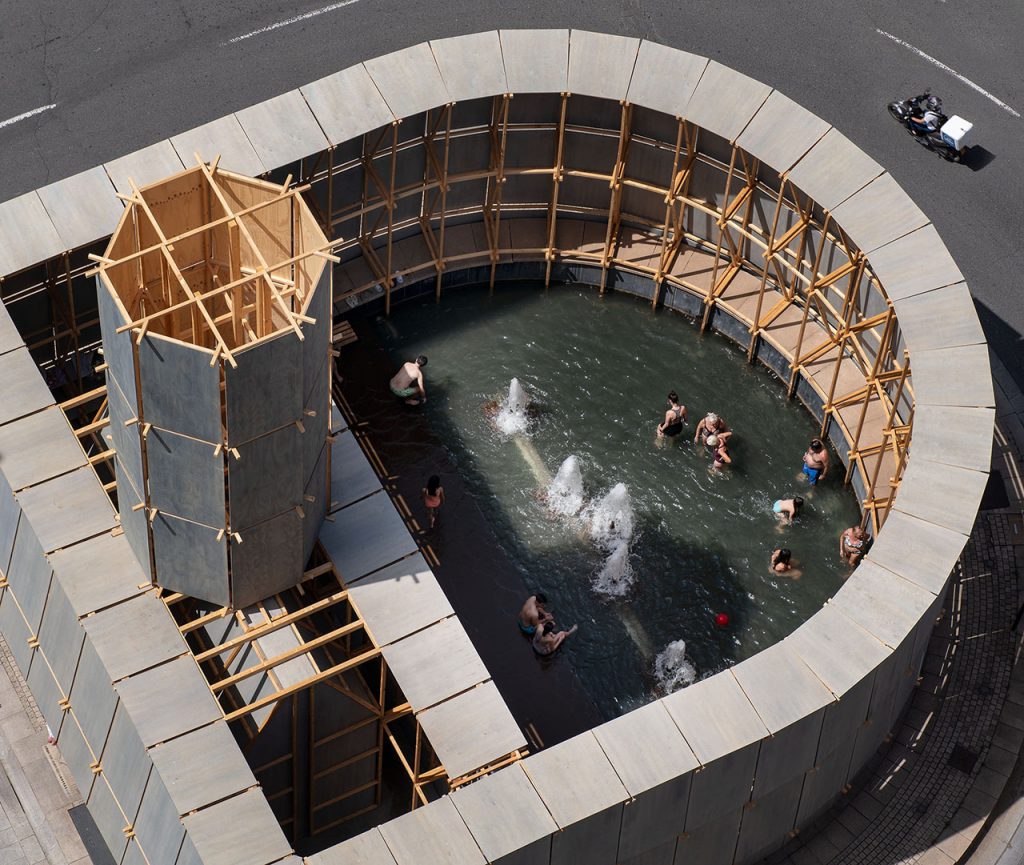
Leopold Banchini Architects, “Round about baths”, 2025
Budget
Money has always shaped architecture. Budgets determine materials, scale, methods of construction, and, ultimately, the social and spatial possibilities of a project. Architecture therefore operates in constant negotiation between ambition and constraint. Designers must translate financial limits into spatial strategies, deciding where to invest, where to simplify, and how to create value beyond cost.
In this sense, money is not merely a restriction; it is also a design instrument. It shapes priorities, hierarchies, and the ways architecture communicates quality, care, and intention. Budget is thus a crucial link between architecture and everyday reality.
Bougie
“Bougie,” derived from bourgeois, refers to a form of aspirational luxury: spaces that signal refinement, comfort, and status through polished finishes, fashionable materials, and curated aesthetics. In architectural discourse, the term carries an ambivalent charge. It may suggest elegance and desirability, but it may also imply theatricality, pretension, or the superficial performance of prestige.
The idea of Budget Bougie emerges precisely from the tension between these terms. It asks how architecture might reinterpret the signs of luxury through resourcefulness rather than expense, transforming limited means into spaces that nevertheless feel generous, refined, and culturally resonant.
Competition Task
Participants are invited to design a temporary pavilion for the area in front of the Estonian Museum of Architecture. The proposal should explore how architecture can produce value, quality, and desirability within the limits of a restricted budget. The pavilion should transform modest means into a spatial experience that feels refined, generous, or luxurious.
Proposals may experiment with new or rediscovered construction methods, creatively reinterpret ordinary materials, or develop collaborative strategies that optimise resources and reduce costs.
Guiding Questions
- How can architecture create value, quality, and desirability within a limited budget?
- Can innovation in construction—whether through new technologies or rediscovered traditional methods—offer more efficient and affordable alternatives to conventional building?
- How might ordinary materials, techniques, or objects be reimagined and reframed as desirable?
- Can collaboration across disciplines reduce costs over a building’s full life cycle, including labour, material use, maintenance, and time?
Competition Area
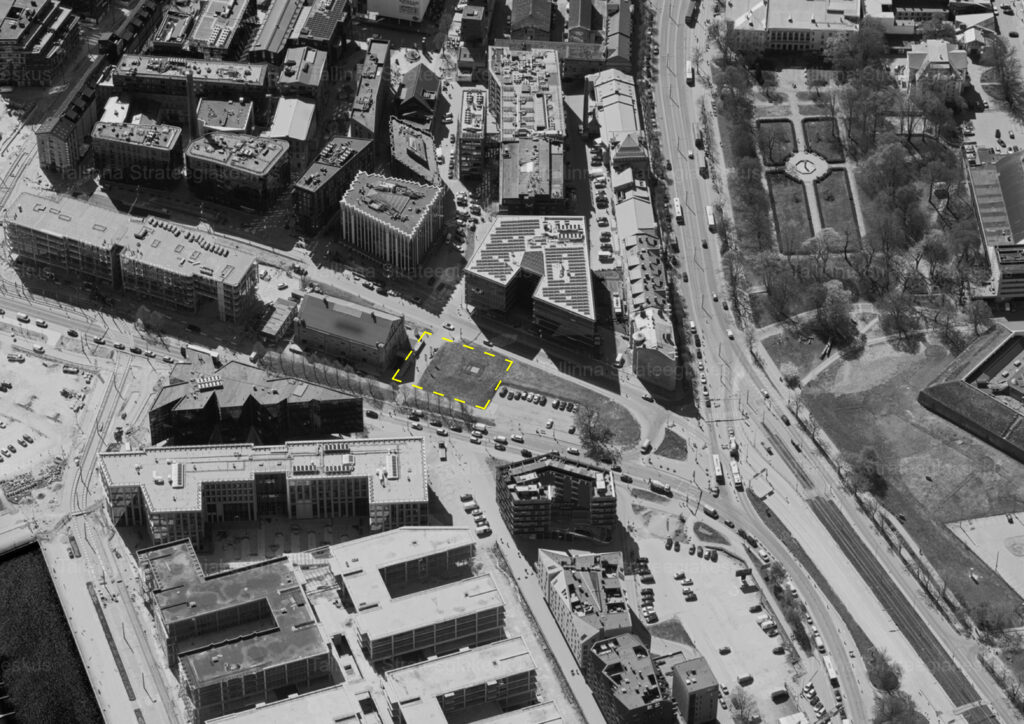
The site for the installation competition is the area in front of the Estonian Museum of Architecture, located at the edge of Tallinn’s Old Town and housed in the historic Rotermann Salt Storage—itself a notable example of the city’s industrial architectural heritage. The area in front of the museum forms part of a lively pedestrian route connecting the harbour and the city Center.
Over the past decade, the surrounding district has undergone rapid development. Recent additions, such as the Golden Gate office building, exemplify a contemporary bourgeois architecture that performs abundance and exuberance through its outer image while often remaining conventional in its underlying logic. Against this backdrop, the proposed Budget Bougie installation is intended to operate as a deliberate contrast.
The construction area includes a paved pedestrian surface alongside a small grass-covered hill. The maximum permitted height of the installation is 5 metres. A pedestrian passage must be maintained between the Estonian Museum of Architecture and the landscape in front of the museum.
Materials
Participants are encouraged to use materials that are readily available in Estonia and commonly employed within the local construction context. Timber is recommended as the primary structural material; however, proposals using other materials are also welcome.
Evaluation Criteria
Entries will be evaluated according to the following criteria:
- compliance with the competition brief and the TAB 2026 curatorial concept;
- feasibility in both budgetary and technical terms;
- technical rigour and clarity of development;
- architectural ingenuity and innovation;
- spatial quality and aesthetic resolution.
Competition Details
Eligibility
The competition is open to individual architects and teams, provided that at least one team member holds a degree in architecture. Participants are not required to hold a professional licence. Students are not eligible.
Prizes and Budget
1st Prize
€2,999 author fee.
The current realisation budget for the installation is €14,999. Successful proposals must be fully realisable within this budget. The amount includes materials, construction, dismantling, transportation, engineering consultations, and travel costs for the authors of the winning proposal.
2nd Prize
€999 author fee.
Feature in the TAB 2026 catalogue and a TAB 2026 pass.
3rd Prize
€499 author fee.
Feature in the TAB 2026 catalogue and a TAB 2026 pass.
Jury
Voting Members
- Elisabeth Terrisse de Botton, architect; author of the previous TAB installation
- Karen Jagodin, head of the Estonian Museum of Architecture
- Kertu Johanna Jõeste, architect; Member of the Curatorial Team TAB 2026
- Sille Pihlak, architect; Dean of the Faculty of Architecture, Estonian Academy of Arts
- Elina Liiva, architect; PhD student, Estonian Academy of Arts
Advisors (non-voting)
- Curatorial team of TAB 2026
- Mariann Drell, Circular Material Strategist at the Estonian Center for Architecture
- Maria Helena Luiga, Project Coordinator of TAB 2026 (M.Arch)
How to Enter
Competition materials can be downloaded here.
There is no registration fee.
The competition is anonymous for the jury. Entries must be identified only by a project code, which is considered to be the project title of at least eight alphanumeric characters. This code must not reveal the identity of the author or authors. Please submit the authors’ information in a separate PDF document, limited to one A4 page.
The official language of the competition is English. All texts, captions, and titles must therefore be submitted in English only.
Entries must be submitted digitally as a .zip or .rar folder (maximum 2 GB) via WeTransfer to info@tab.ee.
By entering the competition, participants grant the Estonian Center for Architecture and the TAB 2026 curatorial team the right to reproduce, translate, publish, exhibit, distribute, and circulate material related to the TAB 2026 Budget Bougie Installation Competition.
Submission Requirements
A3 digital landscape PDF document, less than 20MB, max 8 pages, min 300ppi/vector quality. The competition is anonymous for the jury. Do not indicate any authorship in the presentation, except for the project title.
Name file: A3_(project title)TAB2026 and include:
- 1 page – opening page with project title and cover image;
- 1 page – abstract: a written summary of no more than 500 words explaining the proposal;
- 1-3 pages – key visuals: one cover image or up to three key visuals accompanying the abstract and representing the proposal; Cover image format: 4266 × 3200 px, PNG (RGB), uncompressed, 300 dpi;
- 1-2 pages – key drawing(s) in chosen scale
- 1 page – case studies / precedent projects / research references
Visuals and drawings must also be included as separate files with the submission. Please send a separate document about the authors, one A4 PDF.
Name file: (project title)_team_TAB2026 and include:
- project title
- names of authors/name of practice and location(s)
- short bio of the team or individual members
- contact information (address, e-mail, telephone number)
File Naming Convention
All folders and files must be named according to the following convention:
Folder: Installation_Competition(project title)TAB2026
Presentation: A3(project title)_TAB2026.pdf
Team: (project title)_team_TAB2026.pdf
Image folder: Project images
Images: (project title)_image_1.png
Digital submissions must be received no later than 23:59 EET / 21:59 GMT. Incomplete or late submissions will not be considered.
Deadline and Time Frame
Competition and Construction Schedule
March 2026 — Competition announced
29 April 2026 — Submission deadline, 23:59 EET
06 May 2026 — Announcement of the winning project(s)
August 2026 — Construction of the installation
9 September 2026 — Opening of TAB 2026 and the installation
Questions
Questions must be submitted by email to info@tab.ee no later than 24 April 2026. Questions and answers will be published on the competition webpage.
FAQ
How is the project code determined?
Participants create their own project code. There is no separate registration process for obtaining one. It is recommended to use the project title as the code rather than a numerical identifier, as this helps avoid duplication.
Are there any requirements for the project code?
Yes. The project code must be at least 8 characters long. If the project title is shorter than 8 characters, it may be extended with an additional word or short phrase for the purpose of the code only. This does not affect the project’s official title.
What are the exact dates for the project’s completion? When in August?
The construction period in August will be agreed with the winning team. However, the installation must be fully completed before 24 August 2026.
Do you have a list of online building materials stores so I can estimate the cost of building materials in Tallinn?
A few commonly used building materials suppliers in Estonia are:
- DEPO
- Espak
- K-Rauta
- Bauhaus
- Bauhof
How will the construction be carried out? Will there be a construction company that supplies the materials and carries out the work? Who is responsible for identifying the construction company?
This will be decided together with the winning team. The winning team may either construct the installation themselves or outsource the work to a construction company. If a construction company is used, its costs must be covered within the construction budget.
The Estonian Centre for Architecture will assist in mediating this process. If external builders are engaged, the winning team must provide technical drawings and documentation sufficient for construction. All arrangements must be coordinated and agreed upon between the winning team and the Estonian Centre for Architecture.
What is the expected standing period of the installation pavilion?
The expected standing period of the installation pavilion is 1 to 5 years, depending on the proposal and subsequent agreement. It is expected to remain in front of the Estonian Museum of Architecture for at least one year. In previous editions of TAB, installations have subsequently been relocated to other sites within the city.
Is student participation within a team allowed, and are there any specific conditions or limitations?
Students may be included in a team, provided that they make up no more than one-third of the team.
If a partner for the supply and installation of the timber structures is identified, would it be possible to include the name of the local company within the submitted documents in order to provide a more accurate cost estimate?
The aim is to establish a sponsorship arrangement with a timber producer; however, no such partnership has been confirmed at this stage.
Is it possible to include lighting for the future installation, or is there no access to electricity?
Electricity is available, but the installation should require minimal energy for daily operation.
Can I participate if I already have a Bachelor’s degree in Architecture but am currently still studying for my Master’s degree?
No, not as an individual applicant. Applicants submitting on their own must already hold a Master’s degree. However, you may participate as part of a team, as long as students make up no more than one-third of the team.
Production Information
Production and Realisation
All projects are encouraged to collaborate with the local industry.
The TAB installation operates with a total realisation budget of €14,999 (excluding the honorarium), covering both further design and construction. Successful proposals must be fully realisable within this budget. The amount includes materials, construction, dismantling, transportation, engineering consultations, and travel costs for the authors of the winning proposal.
The winning team will be supported by the Estonian Center for Architecture, which will assist with production and provide advisory support during the realisation process.
Competition Producers
The Estonian Center for Architecture (ECA) was established within the framework of the Year of Architecture in 2008 by the Estonian Academy of Arts and the Union of Estonian Architects. ECA’s activities focus on developing architectural culture in Estonia and promoting contemporary Estonian architecture abroad. ECA is a non-profit institution.
By submitting an entry, participants consent to the publication of their submission by the Estonian Center for Architecture and TAB 2026. The winning team must also agree to the construction of the proposal within the agreed budget and production framework.
Contact
Estonian Center for Architecture
E-mail: info@tab.ee
General phone: +372 611 7436
Address: Kursi tn 3, 10415 Tallinn, Estonia
Appendix
Past Installation Competitions
The installation competition has been a recurring part of the Tallinn Architecture Biennale since its early editions.
For TAB 2013, Tomomi Hayashi (HGA, Estonia) designed and built the first wooden installation for the biennale. The project served as an entrance structure for the TAB 2013 Curator’s Exhibition at the Ministry of Foreign Affairs.
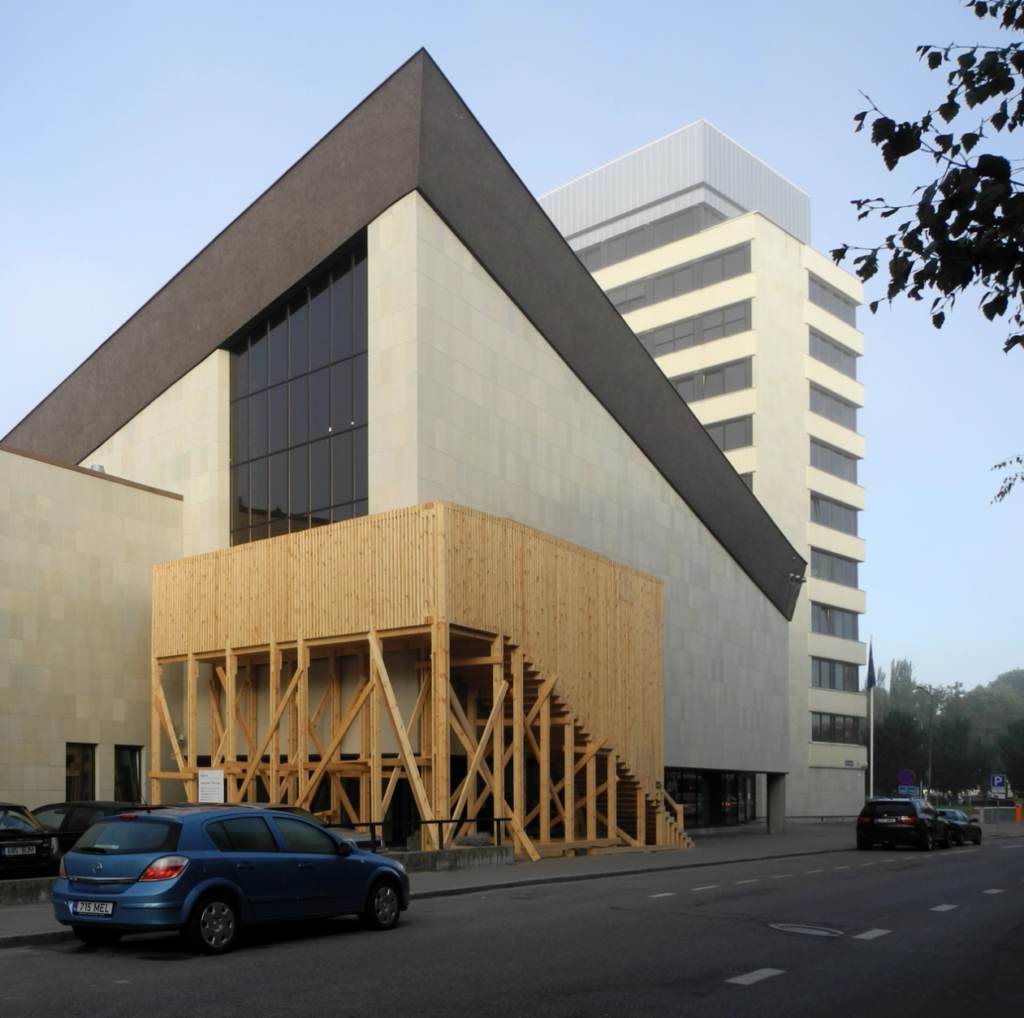
Tomomi Hayashi, “Stair for TAB” 2013.
For TAB 2015, the Estonian office PART (Sille Pihlak and Siim Tuksam) realised an installation based on CNC-cut timber components assembled into a light, web-like pavilion.
For TAB 2017 Gilles Retsin Architecture won the installation competition with a project composed of plywood building blocks, conceived as a contemporary reinterpretation of the Maison Dom-Ino.
For TAB 2019, a pavilion of steam-bent timber elements was developed through analogue tools augmented by the precision of mixed-reality environments. The authors were Gwyllim Jahn, Cameron Newnham, Soomeen Hahm Design, and Igor Pantic.
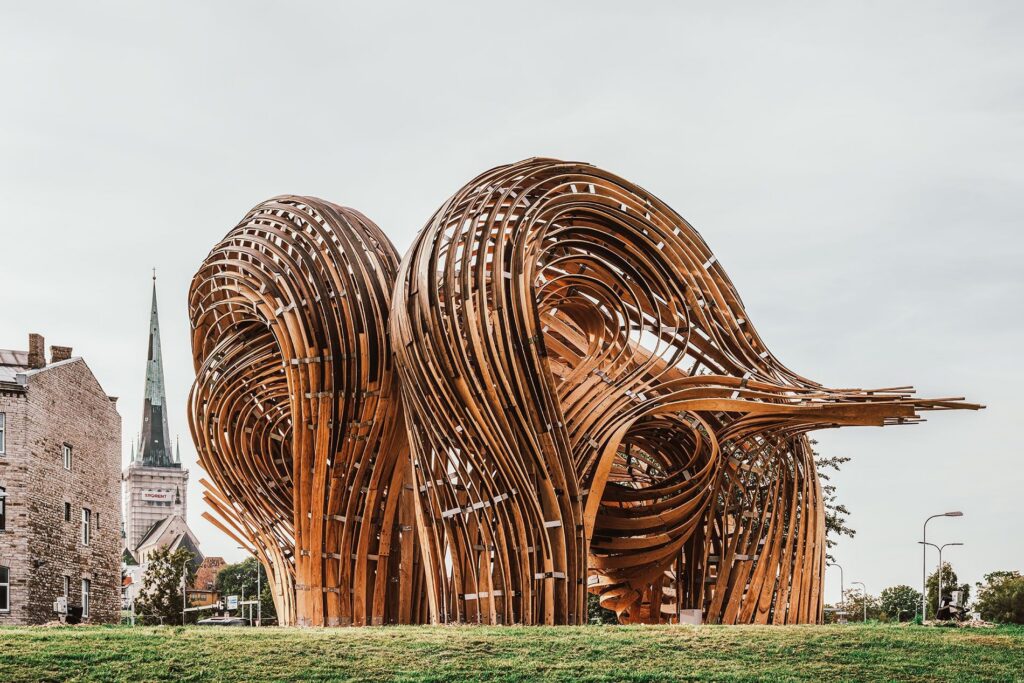
Gwyllim Jahn, Cameron Newnham, Soomeen Hahm Design, Igor Pantic. “Steampunk”, 2019. Photo by Tõnu Tunnel.
For TAB 2022, Fungible Non-Fungible Pavilion, created by iheartblob, introduced a blockchain-funded model of architecture and allowed users to design their own building blocks through an NFT platform.
For TAB 2024, Elisabeth Terrisse de Botton and Matthieu Brasebin realised the pavilion No Time to Waste, a structure made from repurposed and reused resources that offered alternative breakout spaces for city inhabitants.