TAB 2026
9 September – 30 November 2026
Opening week: 9–13 September 2026
Tallinn, Estonia
Curatorial statement
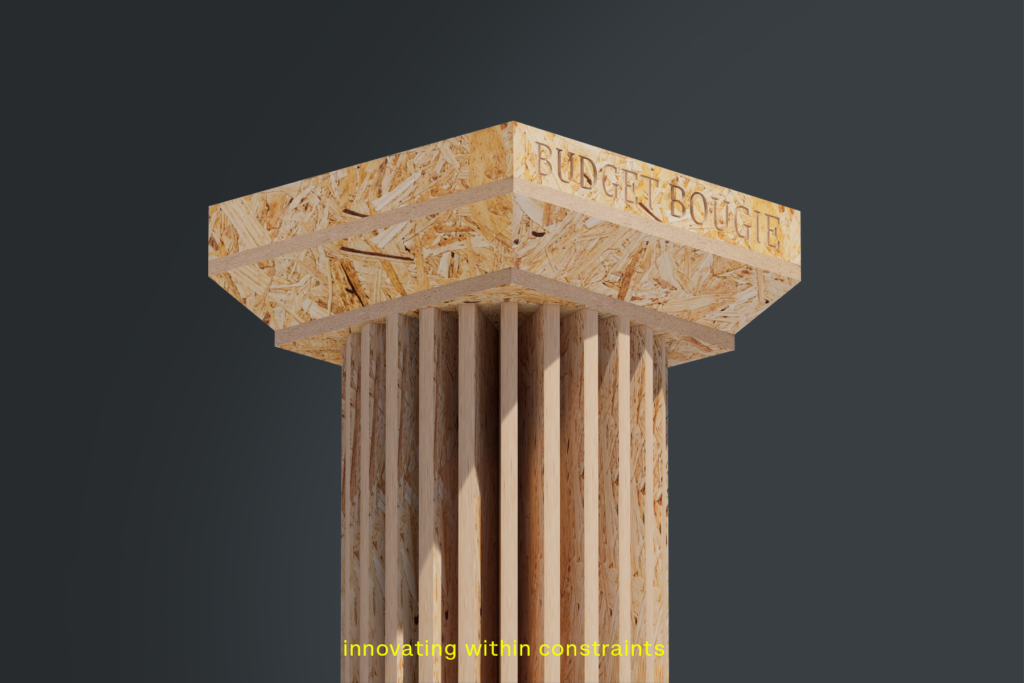
TAB’26 turns attention to the relationship between constraint, cost, and spatial production that has remained suppressed in much of architectural discourse, to unlock new ways of understanding the meaning of value, affordability, and responsibility in architecture.
The notion of ‘cheapness’ in architecture occupies a paradoxical position: it is at once in no way a trait the discipline aspires to, yet it remains a desirable result of construction. More often than not, cheapness in this latter sense, understood as low price, governs architectural production, as market logics flatten building into extractive efficiencies. Architecture, then, is rendered into the infamous Excel sheet that designs most buildings primarily along the lines of cost. Yet what might appear as cheap today obscures how expensive spatial production truly is at large – not only financially at the moment of its construction but also socially, ecologically and throughout time – revealing cheapness as, in many ways, an illusion.
It is within this contradiction that the 8th Tallinn Architecture Biennale (TAB’26), co-curated by Kertu Johanna Jõeste, Siim Tanel Tõnisson, Ra Martin Puhkan (stuudio TÄNA), Mark Aleksander Fischer & Mira Samonig, situates its inquiry. Articulated through the apparently simple premise How much? TAB’26 turns attention to the relationship between constraint, cost and architecture that has remained suppressed in much of architectural discourse, to unlock new ways of understanding the meaning of value, affordability and responsibility in architecture.
Rooted in the Estonian context, the home base of the Biennale, it assembles practices and perspectives to open up this valley of cheapness in both its critical and generative dimensions. In fact, a view of the existing local context already reveals cheapness as a mixed blessing. On the one hand, it places immense pressure on local practitioners, operating within the aftermath of the 1990s shock therapy and a getting-more-out-for-less-put-in market ethos. On the other, from it Tallinn’s most characteristic and valued typology – the Tallinna maja – emerged.
Through its main exhibition and a programme of installations, a vision competition, public interventions, a symposium and collaborations across geographic, academic and artistic fields, TAB’26 surveys the tension between the true cost of cheapness and the inventive capacities that arise under conditions of scarcity.
How much? becomes a lens through which the full spectrum of a building’s impact is considered – from conception and material choices, to use, labour, maintenance, adaptability, and the social infrastructures architecture supports.
History of Tallinn Architecture Biennale
TAB is organised by Estonian Centre for Architecture.
TAB 2024 “Resources for a Future” was curated by Anhelina L. Starkova and co-curated by Daniel A. Walser and Jaan Kuusemets. The biennale examined the diversity of architectural materials, construction approaches, and social planning, with a focus on resource use.
TAB 2022 “Edible; Or, The Architecture of Metabolism” was curated by Lydia Kallipoliti, Areti Markopoulou in collaboration with Chief Local Advisor Ivan Sergejev. In the biennale “food” was approached both literally and metaphorically.
TAB 2019 “Beauty Matters” was curated by Dr Yael Reisner. The biennale focused on the how beauty matters again, reflecting a cultural shift after nearly eighty years of dormancy when beauty was a tabooed and denigrated subject.
TAB 2017 “bioTallinn”, curated by Claudia Pasquero (ecoLogicStudio), challenged the typical assumptions of what constitutes the boundaries between the natural and artificial realms.
TAB 2015 “Self-Driven City”, curated by Marten Kaevats, explored future cities with self-driven cars.
TAB 2013 “Recycling Socialism”, curated by Aet Ader, Kadri Klementi, Karin Tõugu, and Kaidi Õis, redefined the Soviet-era urban environment in Tallinn.
TAB 2011 “Landscape Urbanism”, curated by Villem Tomiste